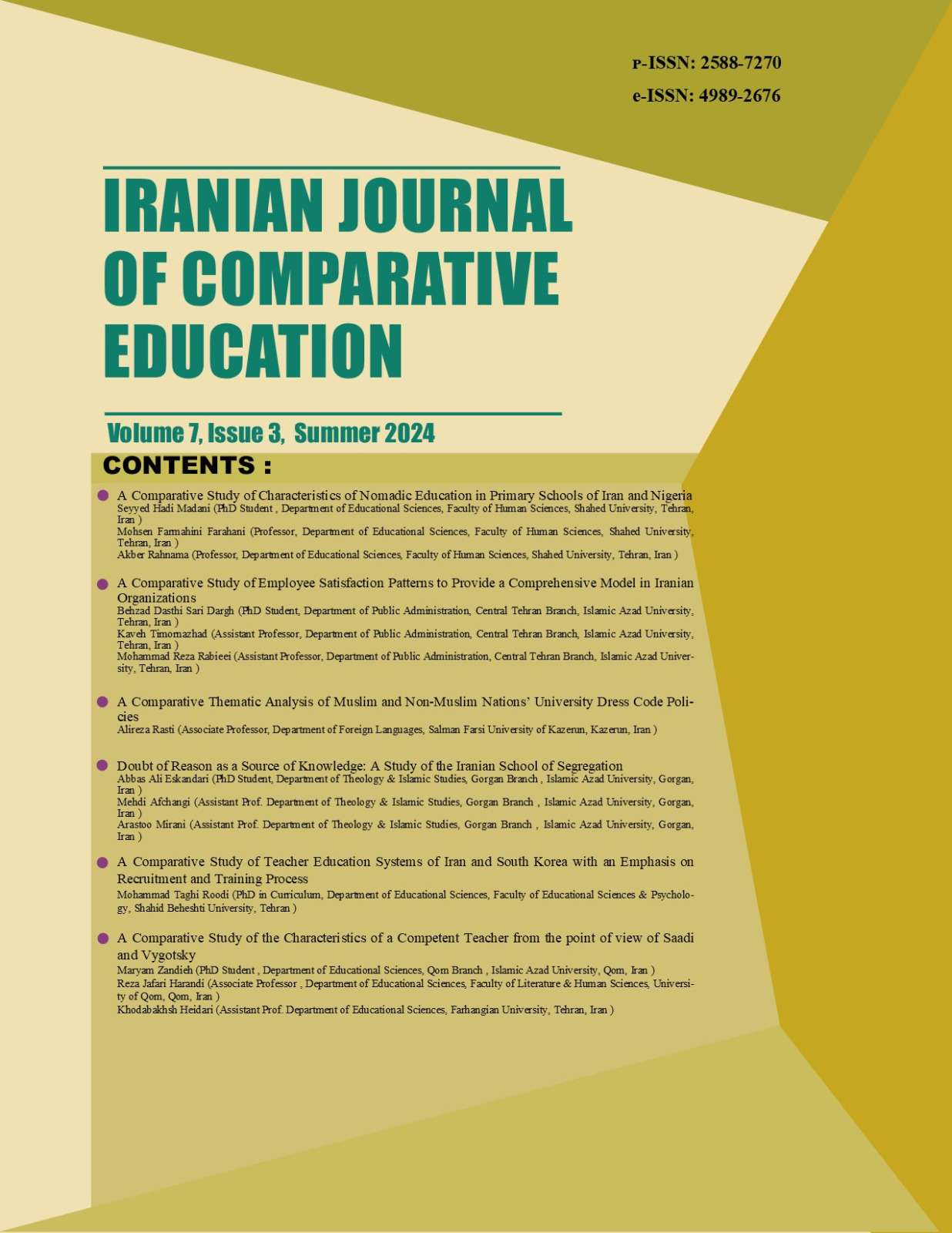
نوع مقاله : Original Article
تازه های تحقیق
-
موضوعات
Employee satisfaction - which should not be confused with their participation in work - is a term that describes people's level of satisfaction with their jobs, experiences, and workplace. Satisfaction is related to elements such as rewards, benefits, recognition, work-life balance, workload, organizational culture, effective leadership, etc. Ensuring that the financial needs of employees are met is very important to improve people's participation in work and to achieve the goals of the organization. In fact, successful organizations are highly dependent on satisfied employees. Based on this, in today's competitive world, pioneering leaders and managers are trying to know the level of job satisfaction of employees. It is obvious that gaining this awareness involves many benefits, such as identifying common problems between employees, increasing the retention rate of efficient employees, communicating between managers and employees, improving methods of promotion and professional growth (Moro, Ramos, & Rita, 2020; Sypniewska, Baran, & Kłos, 2023). Entering the third millennium and the global developments of the last two decades in fields such as technology, health and education show that organizational leaders are facing new challenges. Modern technologies have increased the distance between knowledge and expertise of managers and employees (Cascio, Montealegre, 2016). Health crises and emergence of epidemics - such as Corona - surprised the leaders of organizations in facing new ways of doing work - such as remote work - (Gandrita, Gandrita, & Rosad, 2022).
Various educational methods - which are affected by the development of information and communication technologies - increased the speed of work and its complexity at the same time. These developments, without exception, affected the components and level of job satisfaction of employees. On the one hand, modern technologies and educational advancements have made employees not show much enthusiasm for following the traditional line/headquarters structures in the organization as in the past (OECD, 2018). On the other hand, the occurrence of unforeseen events such as Corona caused employees to get acquainted with new manifestations of job satisfaction while performing organizational duties without leaving their homes. For example, a survey report on the state of remote work published by Owl Lab (2020) shows that 77% of respondents claimed that the possibility of remote work after Covid-19 would make them happier. Also, if the current employers demand a complete return to the organization, 46% of the professionals admitted that they will look for a new job position where they can continue working remotely. Also, 66 percent of employees stated that they would not be happy to work in positions where the possibility of remote work is eliminated, and 54 percent believed that they would be enthusiastic if they remained in roles that prohibit "working from home" and their efforts are reduced. For this reason, paying attention to the job satisfaction of employees and its components has become one of the routine research topics in management faculties and departments. The findings of a number of them are mentioned:
Issa Gazi, Islam, Sobhani & Dhar (2022) by posing the question whether job satisfaction is different at various levels of employees, revealed that payment, appreciation of good work, participation in decision-making, career promotion and good communication with colleagues are very important as determining factors of job satisfaction. Lee, Robertson & Kim (2020) examined the determinants of job satisfaction among US federal employees according to racial and gender differences revealed that between four demographic subgroups (white men, white women, minority men and minority women) in terms of which factors have the strongest effect on satisfaction, there is no significant difference. There is also some evidence of intersectionality, in that pay satisfaction and diversity management are most important to minority women and least important to White men, and workplace participation is most important to White men and least important to minority women. Srimarut and Mokhum (2020) investigated Influence of Workload and Co-Worker Attitude on Job Satisfaction among Employees of Pharmaceutical Industry in Bangkok, Thailand: The Mediating Role of Training. Findings revealed that the workload was an elemental predictor of job satisfaction. The perceived co-worker positive attitude related to a higher level of job satisfaction. Wang & Brower (2019) investigated job satisfaction among federal employees and role of employee interaction with the work environment found that the perceived compatibility between federal employees, their work group, and supervisors has a significant effect on job satisfaction. Alghamdi (2015) looking at the job satisfaction of employees in developing countries (Saudi Arabia) indicated that job satisfaction and life satisfaction have a positive and reciprocal relationship. Also, by controlling the demographic and socio-economic variables, the age variable predicted job satisfaction individually. Yusof, Misiran & Harun (2014) investigated job satisfaction among Malaysian factory workers and showed that there is a significant difference between male workers and single and married workers. Also, the findings - taking into account the age of the respondent groups - show a significant difference in the level of job satisfaction. In a national study in the United States of America, Sweeney, Hohenshil & Fortune (2011) found that age, gender, race and work environment - rural versus non-rural area - did not have a statistically significant effect on job satisfaction. Danielsson and Bodin (2008) investigated the workplace architecture and its relationship with health, well-being and job satisfaction among employees and found that the lowest health status was observed in medium and small offices. Also, the highest health was observed among the employees of small and flexible offices. Employees of these types of offices and offices with common room also had the highest job satisfaction. The lowest job satisfaction was in combined offices followed by open-plan offices with medium size. Differences between employee satisfaction levels can probably be attributed to variations in architectural features. Markovits, Davis, & van Dick (2007) determined the organizational commitment and job satisfaction profiles among Greek private and public sector employees and reveal that effective organizational commitment has the greatest impact on internal and external job satisfaction levels. DeSantis, & Durst (1996) polled more than 12,000 employees of government and non-government organizations and found out that the factors affecting job satisfaction of these two groups are not necessarily the same. Maidani (1991) in a comparative study of Herzberg's two-factor job satisfaction theory found that employee satisfaction in both departments is not related to health factors.
In Iran and during the last two decades, many researches have been conducted regarding the factors and components of job satisfaction. For example, Abron, Safiri and Mirzaei (2019) found that the most important factor in causing unemployment and burnout among the employees of Sharif University of Technology is comparative dissatisfaction. This dissatisfaction arises as a result of some people's feeling of lack of meritocracy and dissatisfaction with the level of salaries or benefits relative to the amount of work, which has consequences such as unemployment, organizational disharmony and leaving the organization. Azarniushan, Mashaikh, & Mohammadi Shirmohalleh (2017) measured the relationship between organizational innovation and teachers' job performance and job satisfaction. The findings revealed that organizational innovation has a significant effect on of teachers’ job satisfaction. Samani, Darwish, Absi, & Safarzadeh (2015) indicated that job satisfaction is the most important indicator influencing employee turnover. Bastani, Mustafaei, Sadeghi Far, Karimi & Hamidi (2014) found that the most important factor affecting job satisfaction among Iranian nurses is the satisfaction of colleagues and most effective factor of their dissatisfaction is the low level of salary and wages. Safi, Mohammadi & Kalahi (2014) by examining the relationship between job satisfaction and conflict management and job burnout among the employees of a medical center found that three components of job burnout (emotional exhaustion, depersonalization and lack of personal success) have an inverse and significant relationship with overall satisfaction. Mirzaei and Fathi (2012) examined level of job satisfaction of the employees of East Azerbaijan Gas Company and found that level of satisfaction with welfare facilities; training & encouragement to the work group, meeting social needs and conflict & role confusion are most related to the level of job satisfaction. Zahedi, Koshki Jahormi, Boudelai & Gholami (2013) investigated the factors affecting the job satisfaction of employees in an industrial factory in the north of Iran and indicated that three indicators of salary & wages, promotion system and welfare facilities had an adverse effect on the level of job satisfaction. Kaldi and Asgari (2003) examined the level of job satisfaction of primary school teachers in Tehran, found that the highest level of job satisfaction of teachers is affected by factors such as social service, moral values, creativity & variety of work, and the lowest level of job satisfaction is affected by factors such as lack of sufficient salary, politics of educational system, and job security.
Despite the abundance of research related to employee job satisfaction, two points should be noted: First, due to the importance of job satisfaction in the process of achieving the organization's goals, in the last few decades, many attempts have been made to identify its components by researchers and experts in management science, but many researchers have not spent much effort to provide a conceptual model of employee satisfaction. Second, the main benefit of preparing and designing a model is to measure job satisfaction based on components and elements that objectively and clearly determine what actions should or should not be taken by organizational leaders and managers. But the important point in this process is that “to what extent the components of a job satisfaction model have gained general acceptance and are comprehensive”. In fact, evaluating and measuring the usefulness of a model becomes more apparent when we find out how difficult it is to measure satisfaction in organizations. Therefore, in order to benefit from the application of the job satisfaction model - and take advantage of its benefits - one must have a correct understanding of the existing models. All this despite the fact that, firstly, there are not many models, and secondly, most of the job satisfaction models are facing serious challenges due to non-observance of scientific principles in data collection, vague definition of components and lack of appropriate tools to measure each component.
These points show the basis of the main problem of the current research and its necessity. Therefore, one of the main steps to improve employee job satisfaction is to identify its basic components and design a relatively comprehensive model that can help organizational leaders and managers in making appropriate decisions to increase employee satisfaction. Considering this brief introduction, the general purpose of research is to examine the comparative study of employee satisfaction patterns to provide a comprehensive model to the leaders of Iranian organizations. According to the overall goal, the sub-goals are:
The research method was qualitatively comparative using content analysis approach. The research population includes all models of employee job satisfaction and the samples were selected through purposive sampling method. Considering the abundance of related sources, sampling continued until reaching theoretical saturation (theoretical saturation in model 14). Documentary method was used to collect data. The search for primary and secondary sources was done through the application of the Boolean method and the identification of basic words - such as job satisfaction, organizational leadership, job commitment, work-home fit, etc. Therefore, primary and secondary sources are searched and identified through international information databases - such as PubMed, Scopus, Web of Science, Google Scholar and Iranian databases - such as (SID), Islamic Scientific Database (ISC), Alamnet, Normag (n=48). External and internal criticism was used to evaluate the validity of the data. To analyze the data was through content analysis method and to analyze the documents, the researchers extracted the components of each pattern and then prepared the tables of juxtaposition and comparison - following the model of agreement & difference of John Stuart Mill.
The results of data analysis are presented in three parts. In the first part, job satisfaction models and each components of each model - along with information about the names of the designers and year of design - are presented. In the second part, juxtaposition of models is done. The third part is dedicated to comparing and determining the similarities and differences, as well as presenting the proposed model.
First: Description of job satisfaction models
Model 1: Job Descriptive Index Model
This model, which is basically a job descriptive index and mostly used to measure job satisfaction, was created in 1969 by Smith, Kendall and Hulin at Cornell University. The descriptive index model measures the job satisfaction of employees through the following five dimensions: a) Job characteristics: the extent to which the job is of interest to the individual and provides the opportunity for growth and acceptance of responsibility. Here, an assessment of the level of satisfaction of the employees is made from things such as diversity & attractiveness of the job, transparency of responsibilities and freedom of action; b) Quality of supervision: technical assistance and social support of the head. Here, the level of employee satisfaction is assessed through the following elements: knowledge & expertise of the boss, the quality of relations with the boss and the support of the boss; c) Communication with colleagues and respect & social balance between colleagues. Here, the employee's satisfaction level is evaluated from things such as relations with colleagues, help of colleagues and behavior of colleagues; d) Advancement opportunities such as chances of advancement and access to advancement opportunities. Here, an evaluation of the level of satisfaction of employees is made from things such as existence of promotion opportunities, organizational training and attention to ideas and finally, e) Payment system, adequacy of payments and the feeling of equality compared to others. Here is an assessment of the level of satisfaction of the employees from things such as the amount of salary, quality of benefits and justice in payments (Behrouzi, Naami, Shukarkan & Taghipour, 2017) (Figure 1).
Figure 1. Job satisfaction components based on Job Description Index Model
In 1967, the Minnesota Job Satisfaction Questionnaire (MSQ) was created by Weiss, Dawis, England, & Lofquist with six components: Pay system, job type, advancement opportunities, organizational climate, leadership style, and physical conditions (Figure 2). The Minnesota Satisfaction Questionnaire was one of the outputs of the "Work Adjustment Project" which is based on the basic assumption that "work fit depends on the fit between the individual and the skills and reinforcements that exist in the work environment" (Martins & Proença, 2012).
Figure 2. Components of job satisfaction based on Minnesota Model
This theory was first proposed by Frederick Herzberg (1968) and specifies the factors that affect the level of satisfaction and motivation of a person. These factors include: job satisfaction (emotional/healthy) and job dissatisfaction (motivational). Health factors are elements of a job that meet basic needs such as safety, rights, fairness and working conditions. When these needs are met, employees feel comfortable and satisfied with their role. Motivational factors are the key elements of a job that encourage people to stay and grow in a role. When these needs are not met, the project team may become dissatisfied with their jobs and look for more challenging roles that allow them to grow professionally, learn new skills, or manage greater responsibilities (Akbar Jan, Raj, & Subramani, 2016).
Figure 3. Components of Job Satisfaction based on Herzberg's Two-Factor Theory
The sphere of influence model is a psychological framework that examines the role of emotions in determining people's job satisfaction. This theory-invented by Edwin Locke in 1976- states that job satisfaction results from the balance between positive and negative emotional experiences in the workplace. According to this theory, higher job satisfaction is caused by more positive feelings and less negative feelings. According to Locke, factors affecting the level of satisfaction can be divided into two general groups of satisfying factors and dissatisfying factors. The first group includes components such as effective leadership, good relationship with managers, personal growth, feedback & support, and clear career goals. The second group has components such as poor pay, inappropriate working conditions, lack of growth and development, lack of profit and lack of job security (Popović, Maletić, Paunović, 2015).
Figure 4. Components of job satisfaction based on Edvin Lock's Range of Influence Model
The job characteristics model provides recommendations on how to better enrich jobs in organizations and was designed by Hackman and Oldham in 1976 (Hackman & Oldham, 1976, 1980). This model provides five characteristics that provide the best job design method, such as: skill variety, task identity, important task, autonomy and feedback. The job characteristics model states that these characteristics affect the results of motivation, satisfaction and performance.
Figure 5. Components of Job Satisfaction based on Hackman & Oldham Model
Equity theory was proposed in the 1960s by behavioral psychologist John Stacey Adams (1965). He stated that jobs include continuous evaluation of the amount of "trade" between the employer and the employee. The main premise of this model is that job satisfaction and motivation are the result of a fair balance between the "inputs" and "outputs" of an employee. Here are some common examples of inputs: Hard work, skill level, passion for work, support for colleagues, and personal sacrifice. The outputs include: Financial reward, recognition & fame, respect & praise, job security and other intangible benefits (Koltko-Rivera, 2006).
Figure 6. Job Satisfaction Components Based on John Stacey Adams' Equality Model
Victor Harold Vroom, a Canadian psychologist and professor at the Yale School of Management, proposed the job expectations model in 1968. This theory works on the assumption that people prefer to maximize pleasure and minimize pain. This means that people will behave in a way that will bring them the best outcome or reward. This theory relies on the idea that the more an employee values the outcome, the more motivated she or he will be to achieve it. Also, the more employees try to succeed, the more satisfied they are with receiving that reward (Park & Kim, 2017).
Figure 7. Components of Job Satisfaction based on Vroom's Expectation Model
Self-Determination Theory is the result of the work of Richard Ryan and Edward Deci as a macro-theory to gain insight into job satisfaction. According to Deci (1971), unlike extrinsic motivation -where activities are pursued for an extrinsic goal-, intrinsic motivation leads to the initiation of behavior for self-reward. This reward can be, for example, interest or satisfaction. According to this model, people can absorb extrinsic motivations into their core feelings and value system and change their behavioral framework. Behind this, three universal needs are recognized as essential for such integration: The need for competence, autonomy, and communication (Ryan and Deci, 2000).
Figure 8. Components of Job Satisfaction based on Ryan and Deci's Self-determination Model
This model was introduced for the first time by three researchers from Bosnia and Herzegovina in the article “Job satisfaction of banking sector employees in the Federation of Bosnia and Herzegovina" (Kozarevic, Peric & Delic, 2014). According to the designers of the model, the main components of job satisfaction are very broad, but they can be summarized in the following elements: Demographic characteristics, management, material rewards, non-material rewards, work environment, work social atmosphere and overall life satisfaction.
Figure 9. Components of Job Satisfaction based on Kozarevic, Peric & Delic Model
This model was published for the first time by Fosam, Grimsley & Wisher (1998) in the article “Exploring models for employee satisfaction with particular reference to a police force" in the Journal of Total Quality Management. According to these designers, job satisfaction is affected by six factors of satisfaction, employee morale, colleague morale, professional development resources & training, quality of services received, and views received from the general public.
Figure 10. Components of Job Satisfaction based on Fosam, Grimsley & Wisher Model
This model was first proposed by two Romanian researchers Bucata and Virca and their Hungarian colleague Popescu (Bucata, Virca & Popescu, 2022). According to these researchers, job satisfaction consists of components such as work-life balance, health benefits, respect, reward & stability, which follow a hierarchical relationship like the needs in Maslow's pyramid.
Figure 11. Components of Job Satisfaction based on Bucata, Virca & Popescu Model
This model was published for the first time by three Vietnamese researchers, Tung, Van Anh &Anh in the article “The Factors Impact on Employee Satisfaction in Work at Vietnamese Garment Enterprises" by the Journal of Business & Management (Tung, Van Anh & Anh, 2019). According to these designers, factors such as training, rewards, working conditions, and relationship with colleagues affect organizational commitment. Organizational commitment also has two consequences, organizational loyalty and job satisfaction. Therefore, the components of organizational commitment are common with the components of job satisfaction.
Figure 12. Components of Job Satisfaction based on Tung, Van Anh &Anh Model
Two African researchers Beyene and Gituma (2017) designed and presented their job satisfaction model by examining the effect of demographic factors of employees on job satisfaction. According to these researchers, the three main factors affecting job satisfaction are demographic factors, internal characteristics of growth & progress in the job, and external characteristics of the job.
Figure 13. Components of Job Satisfaction based on Beyene, & Gituma Model
Affected by the outbreak of the Corona Disease and the increase in remote working hours, the research company "International Team" found that after the end of the corona virus, more than 52% of American employees still want to perform their job duties through both modes of presence at the workplace and remotely provided that the choice of how to do the work is their responsibility. For this reason, this company presented a new job satisfaction model. The components of this model include: A sense of success, optimism of the organization's leader, efficient health insurance plans, mixed work models and work-life balance (International Team, 2021).
Figure 14. Components of Job Satisfaction based on International Team Model
Second. Juxtaposition of Models
In this section, the components of job satisfaction models are put together. Table (1) shows the frequency of the main components of job satisfaction according to model and year of design.
Table (1): Frequency of the main components of job satisfaction according to model and year of design
|
Designer
|
Year of Design |
Components
|
Number of Components |
|
John Stacey Adams
|
1965
|
Financial reward, recognition and fame, respect and praise, job security and other intangible benefits |
5 |
|
Weiss, Dawis, England, & Lofquist |
1967
|
Payment system, job type, advancement opportunities, organizational atmosphere, leadership style and physical conditions |
6 |
|
Frederick Herzberg
|
1968
|
Success, growth, recognition, responsibility, promotion, job nature, management policies, job security, working conditions, social status, mutual relations, salaries and wages. |
12
|
|
Vroom |
1968 |
Effort, Performance, Reward |
3 |
|
Smith, Kendall and Hulin |
1969
|
Job characteristics, supervision quality, communication with colleagues, advancement opportunities, payment system |
5 |
|
Richard Ryan and Edward Deci |
1971
|
Need for competence, autonomy, communication |
3 |
|
Edwin Locke
|
1976
|
Effective leadership, good relationship with managers, personal growth, feedback and support, clear career goals |
5 |
|
Hackman and Oldham |
1976
|
Skill variety, task identity, task importance, autonomy and feedback |
5 |
|
Fosam, Grimsley & Wisher |
1998
|
Satisfaction, employee morale, colleague morale, professional development resources and training, quality of service received and opinion received from the general public |
6 |
|
Kozarevic, Peric & Delic |
2014
|
Demographic characteristics, management, material rewards, non-material rewards, work environment, work social atmosphere and overall life satisfaction |
7 |
|
Beyene, &Gituma |
2017
|
Demographic factors, internal characteristics of growth and advancement in the job, external characteristics of the job |
3 |
|
Tung, Van Anh & Anh |
2019
|
Training, bonuses, working conditions, relationship with colleagues |
4 |
|
International Team
|
2020 |
A sense of accomplishment, organizational leader optimism, efficient health insurance plans, mixed work models and work-life balance |
5 |
|
Bucata, Virca & Popescu |
2022 |
Work-life balance, health insurance, respect, rewards and stability |
5 |
According to the data in Table 1, the following can be inferred in the juxtaposition phase of models:
Third. Comparison of job satisfaction models
The data obtained from the two stages of description and juxtaposition show that the designers of job satisfaction models have used sometimes synonymous words for the components. Based on this, after identifying the synonymous components, Table 2 was prepared to show which component has the highest degree of similarity and difference between the selected models. In other words, the purpose of this section is to identify the similarities and differences of job satisfaction models in terms of components.
Table (2) Comparison of different models of job satisfaction according to similarities and differences of components
|
Model/component
|
Demographic factors
|
Work-life balance
|
respect
|
Relationship with colleagues
|
Job stability |
payment system
|
success and progress |
diversity of work method
|
Effective leadership
|
health insurance |
|
John Stacey Adams
|
- |
- |
* |
- |
* |
* |
- |
- |
- |
- |
|
Weiss, Dawis, England, & Lofquist |
- |
- |
- |
- |
- |
* |
* |
* |
* |
- |
|
Frederick Herzberg
|
- |
- |
* |
* |
* |
* |
* |
* |
* |
- |
|
Vroom |
- |
- |
- |
- |
* |
* |
- |
- |
- |
- |
|
Smith, Kendall and Hulin |
- |
- |
- |
* |
- |
* |
* |
* |
* |
- |
|
Ryan and Deci |
- |
- |
- |
* |
- |
- |
* |
* |
- |
- |
|
Edwin Locke
|
- |
- |
* |
- |
- |
- |
* |
|
* |
- |
|
Hackman and Oldham
|
- |
* |
- |
- |
* |
- |
- |
- |
- |
- |
|
Fosam, Grimsley & Wisher |
- |
- |
* |
* |
- |
* |
- |
- |
- |
- |
|
Kozarevic, Peric & Delic |
* |
* |
- |
- |
* |
* |
- |
* |
- |
- |
|
Beyene, &Gituma |
* |
- |
- |
* |
- |
- |
* |
* |
- |
- |
|
Tung, Van Anh & Anh |
- |
- |
- |
* |
- |
* |
|
* |
- |
- |
|
International Team
|
- |
* |
- |
- |
- |
- |
* |
* |
* |
* |
|
Bucata, Virca & Popescu |
- |
* |
* |
- |
* |
* |
- |
- |
- |
* |
The data analysis shows that ten components can be mentioned which are expressed in most of the models. These components include demographic factors, work-life balance, respect, relationship with colleagues, job stability, pay system, success & advancement, diversity in work practices, effective leadership, and health insurance. Based on this, the following can be inferred from the data in Table 2:
According to the above-mentioned points, it is now possible to choose the components that are more interested by management experts and researchers and there is a general consensus about them, according to the abundance of components in the selected models .Then, for use in Iranian organizations, these components can be included in the proposed model of job satisfaction:
|
|
Figure 15: Proposed job satisfaction model for Iranian organizations
The proposed model includes six components that are repeated more than other components in the selected models. In fact, among the 74 components in fourteen selected models, these six components have the maximum acceptance among management science experts in terms of shaping the process of employee satisfaction or dissatisfaction. Another point about these components in the proposed model is that they are not culture-oriented and can be used in all governmental and non-governmental organizations regardless of the influence of social structure and organizational traditions. For this reason, the leaders and organizational managers of Iran should pay special attention to these components - which are mostly objectively measurable - to improve the job satisfaction of their employees.
Increasing employee job satisfaction is generally not among the priorities of leaders and managers of organizations. They are more in pursuit of achieving the goals of the organization and its interests. The structure of the management system in Iran organizations follows this model more strictly. Traditionally, managers of organizations in Iran - especially in the public sector - are less concerned about obtaining employee satisfaction. Therefore, we often see a deep gap between managers' demands and employees' expectations. It is obvious that this gap cannot be sustained. For this reason, in recent years, the attention of politicians, statesmen, leaders and managers, as well as management researchers, has increased to the awareness of employee satisfaction methods and strategies. Meanwhile, job satisfaction models are practical guidelines for managers. They determine what components can increase the job satisfaction of employees.
During the past half century, various models have been prepared and developed to determine the dimensions and components of job satisfaction. These models have been prepared for various organizations and companies - public and private - as well as different economic sectors - agriculture, industry and services. Naturally, this issue creates limitations for the use of each model in a different organizational context. For this reason, each of the job satisfaction models has its own advantages and limitations, and may not be applicable in all organizations. In addition, some models are specifically designed for use in commercial and profit-oriented organizations, while others are applicable to non-commercial organizations – educational or social/cultural organizations. Therefore, selection a model that can pay attention to the most important components of job satisfaction while being relatively comprehensive has become a challenge for leaders and managers of organizations. In other words, it is difficult for managers to prepare, formulate and implement a suitable model for any organization - from a scientific and financial point of view-, while time limits, organizational & personal competitions, and employee expectations also do not allow trial and error. Therefore, choosing a relatively comprehensive model through the review and comparison of existing models is a rational method. Based on this thought, the purpose of this research was to examine job satisfaction models and provide a proposed model for Iranian organizations.
The findings of research reveal that ten components of work-life balance, demographic factors, respect, relationship with colleagues, job stability, payment system, success & progress, diversity in work methods, effective leadership and health insurance are common in most of the selected models. In other words, some of these components are present in most models, while some are only seen in two or three models. Another finding indicates that the two components of payment system and diversity in work methods are most important components from the point of view of the designers of models. In fact, the findings of previous researches - both at the international level and in Iran - defend the fact that the payment system and its sub-variables such as financial & material rewards, reward system, and medical services strongly affect the level of satisfaction. This situation is more evident in organizations in societies that are severely affected by inflation and periodic economic recession - such as Iran. Also, diversity in the ways of doing work - especially after the outbreak of Corona and the increase in working hours - is an effective factor for improving the job satisfaction of employees.
Regarding the proposed model, it should be said that the choice of a special job satisfaction model and its application in organizations strongly depends on the values, goals, missions, resources & needs, organizational culture and ability of managers & employees. Therefore, management experts and organizational leaders should carefully choose the most suitable model according to the role of these variables. By considering the conditions of organizations in Iran, the researchers tried to firstly, present a model that is not affected by the social context and factors such as ethnic and linguistic culture, and secondly, they selected most important components of selected models - considering approach of repetition, similarity and difference. In addition, considering the complexity of the models and organizational conditions in Iran, it is suggested that the managers select a suitable period of time - one year or five years – to evaluate the proposed model. It is also recommended organizations leaders to add some other components in proposed model - which are more suitable to the goals and functions of their organization - or remove the inappropriate component.
-