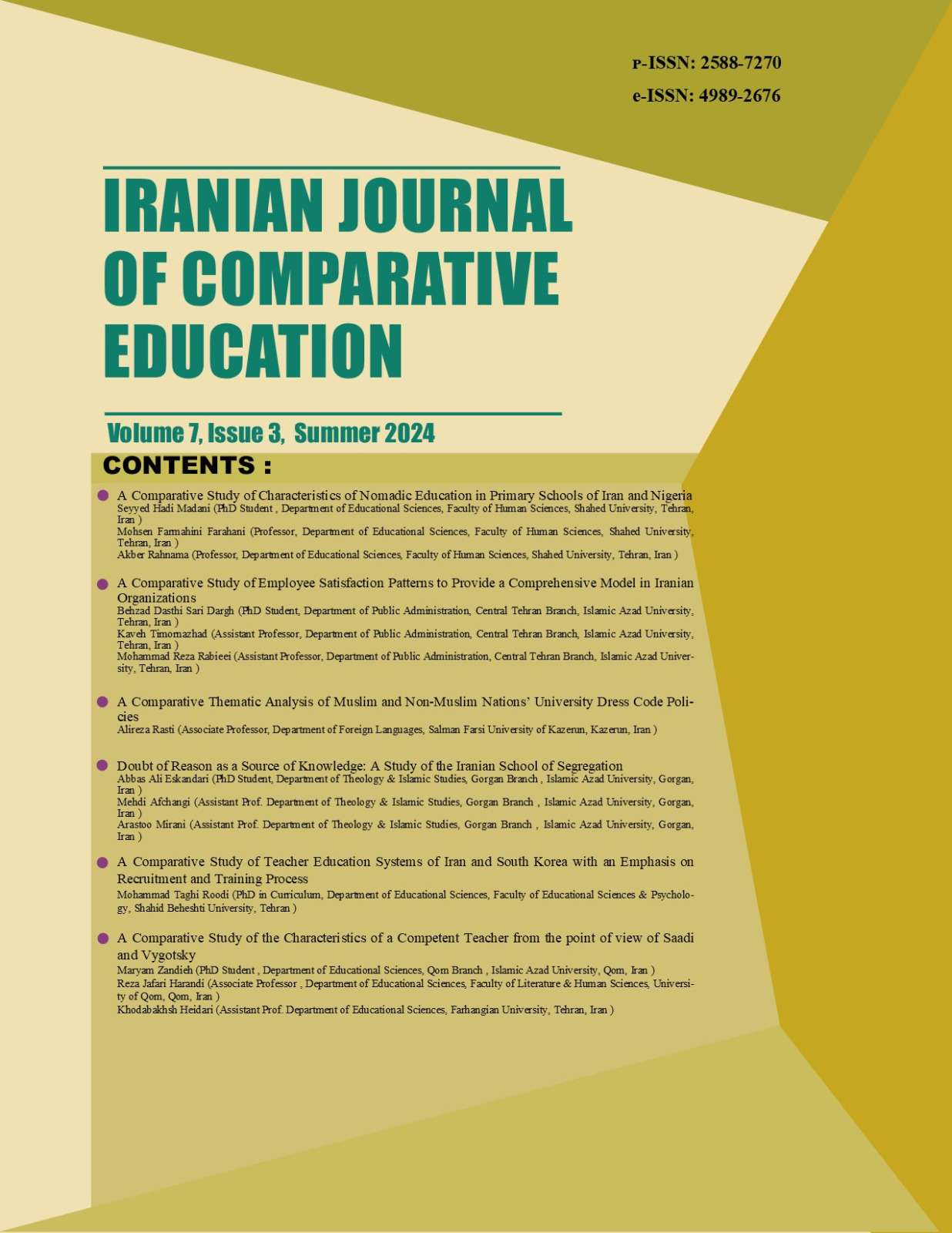
نوع مقاله : Original Article
تازه های تحقیق
-
موضوعات
Nowadays, the progress of society and citizens is among the most important issues. Undoubtedly, a significant part of this progress depends on proper education from childhood to adulthood. Teacher is among the major and influential factors in the teaching and learning process, so that teacher’s speech, behavior and character are always considered as an effective element in education (Garcia, Kupczynski & Glenda, 2011). Certainly, epistemological fields of humanities have always been in a constructive relationship with each other for explaining the characteristics of a competent teacher.
The relationship between psychology and literature is among the most important examples of this constructive relationship (Rostami and Khosravi, 2019). Both psychologists and poets have been interested in education and expressing the characteristics of a competent teacher. Among Iranian Muslim scholars, poets have a particular place and educational topics are often observed in their works. Ferdowsi, Hafez, Saadi & Molavi are Iranian poets who are well-known worldwide. As evidenced by his works, Saadi Shirazi sought education more than most of the eastern poets. By studying Saadi’s literary works, one could notice that words like master, mentor and guide are abundantly used, indicating high status of teacher in his works (Mohammadzadeh, 2016).
Also, many psychologists have investigated characteristics of a competent teacher, among whom Vygotsky, a Marxist from the former Soviet Union, is prominent (Vygotsky, 2021). His sociocultural theory of cognitive development is among the major theories in psychology. Vygotsky considered cultural, historical and social aspects important in cognitive development, and believed that the interaction between the learner and social environment is the main determinant of their cognitive development. Moreover, he maintains that one’s knowledge, thoughts, attitudes and values evolve in interaction with others (Seif, 2016). Vygotsky is one of the most influential individuals in this field by expressing his perspectives on education, so that his principles could be cited in education. It is worth mentioning that a few decades later, with the emergence of the Soviet political and cultural environment, his opinions were spread and received attention in the West. Given that Vygotsky performed many studies on psychology and education, his opinions could contribute to identifying the characteristics of competent teachers. Therefore, the present study aims to compare Vygotsky and Saadi’s perspectives.
Reviewing the literature revealed some researchers have combined literature with psychology. Keshavarzi, Haqiqat and Sadagati (2022) conducted a comparative study on the desired personality model from Rumi’s perspective using psychoanalytical approach. According to Rumi, the desired personality model includs components such as adopting to the environment, not projecting, inner joy, coping with sadness, having a true or real character, being open to criticism and not being a fault-finder. Azimi (2020) conducted a comparative study on Thorndike’s law of effect with Saadi’s Golestan and concluded that Saadi’s practical concepts are consistent with Thorndike’s law of effect. Azizi, Heidarinia and Fallah (2019) conducted a study on the psychological components of Gillberg’s compassion in Saadi’s Bustan and found that the human concepts were proposed by Saadi hundreds of years before the formation of these concepts in psychology. Davarpanah (2019) conducted a comparative study on Vygotsky and Bruner’s perspectives on teaching-learning processes and found that their perspectives were similar in terms of the influence of language and culture on cognitive development, interaction between adults and children in problem-solving situations and using the concept of support in learning, but different in educational patterns, role of thinking and language and cognitive development stages. Pirouz and Ghafouri (2017) analyzed Attar Neyshaburi’s Conference of the Birds (Mantiq al-Tair) and Mosibat Nameh based on Bruner and Vygotsky’s constructivist theory and found that these two theories were compatible with topics of Mantiq al-Tair and Mosibat Nameh, e.g., in these two books, Attar sought to explain mystical conduct with Murad’s leadership and achieve personality transformation in the educational relationship between Murad and Murid (Leader and follower). These topics were also addressed by Bruner and Vygotsky, who are constructivist psychologists. Mohammadzadeh (2016) investigated education in Saadi’s works and found that Saadi considered childhood and adolescence as the most important stages of education. He believed that both heredity and environment could have a significant impact on child upbringing, taking into account individual differences. Hasani Ranjbar and Ebrahimi (2015) conducted a comparative study on education in Saadi and Tagor’s poems. Both poets considered education focusing on God and self-purification desirable and paid attention to aspects such as death, old age, women and education. However, differences could be found between their views, e.g., Saadi believed in the life after death, but Tagor considered death as a barrier to reach God. Banan Khorshid (2015) compared educational views of Saadi and Jean Jacques Rousseau and found that Rousseau had goals such as educating social citizens in accordance with God’s laws of order and reason, nature and flourishing of human existence and natural characteristics, while Saadi had goals such as faith, self-reliance, contentment, love and humility.
Reviewing the literature showed no comparative research has ever been conducted on Saadi and Vygotsky’s perspectives on teacher’s characteristics. To fill this research gap, the researchers aim to respond to the following two questions:
Comparative approach and qualitative content analysis were used as research methods. The research community included Saadi and Vygotsky’s written works, which were selected using convenience and census sampling methods. Therefore, the community and samples were the same. The data, including primary and secondary sources, were collected using documentary method. Considering the research nature, theme analysis (open, selective and axial coding) was used to analyze the data and respond the questions about Saadi, and qualitative content analysis was used to analyze the data about Vygotsky. Data analysis was performed using Bereday’s four-stage model (1964), including description, interpretation, juxtaposition and comparison. Saadi's works including two books of Golestan and Bostan, poems and prose, sonnets and odes were examined. Moreover, sections that were thematically more associated with the research subject, including education, were completely studied in Golestan and Bustan. By analyzing the obtained content, coding was first done and, then, the core categories were introduced as the main indicators. Given that Saadi is a poet, identifying hidden information as well as metaphors, allusions, literary arrays and similes were of special interest in the theme analysis. Attempts were made to find out the characteristics of a competent teacher by studying Saadi’s works and compare the final obtained categories with Vygotsky’s sociocultural theory. For this comparison, Bereday’s four-stage model (description, interpretation, juxtaposition and comparison) was used. Data validation was done using credibility methods through researchers’ self-review during the data collection and analysis process. Dependability was determined by accurate guidance of data collection and coding and analysis procedures. Observing at least two strategies in each qualitative research could provide an acceptable credibility for the research (Creswell, 2012).
First Question: What are the similarities between Saadi and Vygotsky’s perspectives on the characteristics of a competent teacher?
To respond to this question, Bereday’s four-stage model was implemented. In the first stage, a competent teacher is described and interpreted based on Saadi’s view, in second stage, a competent teacher is described and interpreted based on Vygotsky’s view and in third stage, the juxtaposition of these two views is discussed and the similarities and differences are mentioned.
Abu Muhammad Musharraf al-Din al-Muslih bin Abdullah bin Musharraf (1210-1291 AD), known by his pen-name Saadi, completed his early education in Shiraz with the help of his father. In his youth, he moved to Baghdad and studied literature and theology at Nezamiyeh School of Baghdad. Saadi’s life coincided with the Mongol invasion in Iran (Khanlari, Namdari and Talaei Tabar, 2017). Saadi went on a long journey due to his passion for tourism and the Mongol invasion, which lasted for about 35 years (Zehtabi, 2009). Saadi’s works include moral, wise and gentle themes (Khanlari, Namdari & Talaei Tabar, 2017). Saadi’s lyrics are often romantic and describe earthly love. However, he also wrote instructive and mystical lyrics. Golestan and Bustan are known as ethical books, which have influenced Western thinkers, including Voltaire and Goethe, in addition to Persian speakers. Bustan is written in order and includes about 4,000 verses. This is an ethical and educational book, in which Saadi depicted his desired utopia. This book contains 10 chapters, including justice, beneficence, love, humility, contentment, remembrance, education, thanksgiving, repentance and supplications (Kumar, 2022). Golestan is written in melodious prose mixed with order and contains 8 chapters, including manners of kings, morals of dervishes, excellence of contentment, advantages of silence, love and youth, weakness and old age, effects of education and master of speech. Golestan book could be considered as Saadi’s report on the society of his time, in which the sociocultural conditions of people’s lives are realistically depicted (Zehtabi, 2010).
Considering the family and sociocultural conditions of Saadi’s era, characteristics of a competent teacher represented in his works are analyzed. In this section, open, selective and axial codes are extracted from Saadi’s Kulliyat (collected works), including Golestan, Bustan, poems in prose, collection of sonnets and odes, using thematic analysis. Teacher’s characteristic is among the points that Saadi addressed in his works. In his opinion, teachers should have qualities to be able to approach students to their true destination, i.e., perfection and prosperity. In the following, these characteristics are summarized:
Table 1. Open codes extracted from Saadi’s works
|
No. |
Poem |
Open codes |
|
1 |
One day, his gaze fell upon this humble soul, I saw a tutor with a heart not whole. He blocked the sun from shining on my face, Like a heavy cloud, he took its place (Saadi, 2018, p. 759) |
Having positive attitudes towards students and being benevolent |
|
2 |
All my kin were scholars of divine, Yet your love taught me poetry, so fine. (Saadi, 2018, p. 355).
The slave with a ring in his ear, if not cherished will depart. Be kind because then a stranger will become thy slave. (Saadi, 2018, p. 16) |
Teacher-student emotional bond |
|
3 |
A teacher did not grant you wit or sense, God placed this trait in your essence (Saadi, 2008, p. 294)
When you wish that your name may be permanent here, |
Paying attention to development of reasoning and analytical skills, not only transferring knowledge |
|
4 |
Once the boy said to him: ‘As thou strive to direct my studies, direct also my behavior. If thou perceive anything reprievable in my conduct, although it may seem approvable to me, inform me thereof that I may endeavor to change it.’ He replied: ‘O boy, make that request to someone else because the eyes with which I look upon thee behold nothing but virtues.’ (Saadi, 2018, p. 89) |
Upbringing along with education |
|
5 |
It is the duty of a royal prince’s tutor to train up the sons of his lord in refinement of morals (Saadi, 2018, p. 149) |
Developing moral virtues in students |
|
6 |
Excessive anger brings about dread, Untimely kindness strips away respect instead. Be not so harsh that they from you depart, Nor so gentle that they grow bold in heart. (Saadi, 2018, p. 176) |
Being friendly and gentle |
|
7 |
A blend of harshness and gentleness is best, Like a surgeon who both cuts and heals with zest (Saadi, 1989, p. 167) A wise man should not ignore a fool's slight, For it harms both sides: his awe dims, his folly takes flight. (Saadi, 2018, p. 135) |
Being decisive in dealing with learners |
|
8 |
Beasts are silent, while humans speak clear, Better mute than speak ill, I fear. When humans speak, it should be with care, Or better to be silent, like beasts everywhere. Speech and wisdom reveal man's grace, Don't be a parrot, speaking without base. Speech elevates man above the herd, But beasts are better if you speak an ill word (Saadi, 2018, p. 277) |
Admitting what they do not know and avoiding providing false information |
|
9 |
If a man is blessed with skill and art, His craft speaks for him, not his boastful heart (Saadi, 2004, p. 277) --------- This remark reached the ear of the old, village lord; Of unspeakable words, first, your mouth you should scour! (Saadi, 2018, p. 290) --------- Saadi, although eloquent and a speaker of truths, Action comes from deeds, not from mere words (Saadi, 2018, p. 634) --------- No matter how much knowledge you acquire, If there is no action within you, you remain ignorant. (Saadi, 2018, p. 173) |
Being pragmatic and a behavioral model
|
|
10 |
Speak what you know to be of benefit and true, Even if it pleases no one but you (Saadi, 2018, p. 284) |
Free thinking |
|
11 |
Many are the days when hardship endures, The son, like the father, nurtures delicate cure (Saadi, 2018, p. 286) Revere the wise and the temperate, If you cherish them, refrain from overindulgence (Saadi, 2004, p. 256) --------- Every child subjected to a harsh teacher's taunt, Sees not just cruelty but a lesson to confront (Saadi, 2018, p. 286) --------- A teacher, when gentle and free of strife, Children frolic like bears and hawks in life." (Saadi, 2018, p. 150) |
Being serious and avoiding gross negligence
|
|
12 |
For the novice, mention and praise inspire, From the teacher, it's correction and warning that acquire (Saadi, 2018, p. 286) --------- If you wish to succeed, approach with gentleness and wit, Avoid haste, anger, and roughness in your bid (Saadi, 2018, p. 193)
|
Encouraging more rather than punishing |
|
13 |
Teach the nurtured one restraint and modesty, Or else, if you possess riches like Croesus, with mastery (Saadi, 2018, p. 286) |
Teaching and transferring processes rather than presenting achievements / promoting effort and persistence in students |
|
14 |
Let the purse of silver and gold reach its end, May not the tradesman's purse be empty, my friend. When a trade is at hand, within easy reach, Where will one's hand of need go to beseech (Saadi, 1989, p. 234) |
Skills training |
|
15 |
A good sword, when wielded by one who knows, Can turn base iron into fine steel, it shows. Without proper upbringing, oh wise one, beware, Even gentle rain can't make thistles bloom fair. In the garden, tulips blossom with grace, While barren soil brings forth only base (Saadi, 2018, p. 21) --------- One whose foundation is flawed can't catch the rays of the good, Upbringing for the unfit is like dust on a dome, understood." (Saadi, 2018, p. 21) --------- When the essence of a gem is worthy, Education leaves its mark, quite sturdy. No fine polishing can ever redeem, Iron that's rusted, lost in esteem (Saadi, 2018, p. 109)
The path of love cannot be taught through speech, Except by one naturally inclined to reach (Saadi, 1989, p. 128) ------- He said: 'By the decree of the Lord, the face of the earth is not covered so that education is uniform, and temperaments differ (Saadi, 2018, p. 153) |
Paying attention to learners’ inherent and personality traits |
|
16 |
Untapped talent is a waste without education, And education of the untalented is in vain. (Saadi, 2019, p. 185) |
Adapting education to learners’ talent |
|
17 |
I saw a schoolmaster in the Maghrib country, who was sour-faced, of uncouth speech, ill-humored, troublesome to the people, of a beggarly nature and without self-restraint; so that the very sight of him disgusted the Believers and when reading the Quran he distressed the hearts of the people. A number of innocent boys and little maidens suffered from the hand of his tyranny, venturing neither to laugh nor to speak because he would slap the silver-cheeks of some and put the crystal legs of others into the stocks. In short, I heard that when his behavior had attained some notoriety, he was expelled from the school and another installed as corrector, who happened to be a religious, meek, good and wise man. He spoke only when necessary and found no occasion to deal harshly with anyone (Saadi, 2018, p. 110) |
Avoiding punishment, especially physical punishment |
|
18 |
They asked Luqman, 'From whom did you learn wisdom?' He said, 'From the blind, because they do not step beyond what they see (Saadi, 2019, p. 13) |
Indirect education |
|
19 |
Two people endured pointless suffering and exerted futile effort: One who harvested and did not eat, and the other who learned and did not practice (Saadi, 2018, p. 125) |
Practical education |
|
20 |
However, the servant hopes to gain upbringing in the company of the righteous and adopt the disposition of the wise, for he is still a child and the inclination towards wrongdoing and stubbornness has not yet firmly taken root in his nature." (Saadi, 2018, 14) |
Paying attention to learners’ cognitive developmental characteristics |
|
21 |
I have heard that a royal prince of short stature and mean presence, whose brothers were tall and good looking, once saw his father glancing on him with aversion and contempt but he had the shrewdness and penetration to guess the meaning and said: ‘O father, a puny intelligent fellow is better than a tall ignorant man, neither is everything bigger in stature higher in price (Saadi, 2019, p. 17) |
Not discriminating among students |
|
22 |
One whose foundation is bad cannot receive the radiance of the virtuous, Upbringing for the unworthy is like dust on a dome (Saadi, 2018, p. 20) |
Paying attention to resistance of some students to education |
|
23 |
The Minister heard these sentiments, approved of them nolens volens, praised the opinion of the king and said: ‘What my lord has uttered is the very truth itself because if the boy had been brought up in the company of those wicked men, he would have become one of themselves (Saadi, 2018, p. 14) |
Within-person variance |
|
24 |
Behave with grace, and the malicious will be silenced, They'll find no opportunity to mention your flaws. When the melody is in harmony with the lute, How could the listener complain about the musician's skill (Saadi, 2018, p. 253) |
Being patient with non-conformist students |
|
25 |
Many a hungry one has slept, unrecognized, Many a soul has reached its lips, unnoticed by others (Saadi, 1989, p. 78) |
Paying attention to students’ problems and living conditions |
|
26 |
Do not be expansive in action if you desire, So that the time of your removal leaves enemies no room. Be pure and avoid others, O brother, with care, For dirty clothes are cleaned by rubbing against a stone"(Saadi, 1989, p. 68) |
Teacher’s courage |
|
27 |
I once said, 'I was merely insignificant as a flower, But I sat with the rose for a while.' The perfection of the companion left an impression on me, Otherwise, I am still just the dust that I am." (Saadi, 2018, p. 3) |
Good neighborliness and companionship |
|
28 |
When a task without frivolity befalls me, I find myself unable to speak about it. Even if I see it's futile or like a pit to the blind, Remaining silent then would be a fault of mine (Saadi, 2004, p. 35) |
Facilitating, instead of teaching in an authoritarian manner |
|
29 |
One of the great devotees having been asked about his opinion concerning a hermit whom others had censured in their conversation, he replied: ‘I do not see any external blemishes on him and do not know of internal ones. (Saadi, 2018, p. 16) |
Paying attention to students’ inner states / avoiding prejudice |
|
30 |
If the listener does not understand the speech, Do not seek eloquence from the speaker. Bring forth the expansiveness of heartfelt devotion, So the eloquent speaker may articulate boldly. (Saadi, 2004, p. 44) |
Harmonizing education content with learners’ cognitive capacity |
|
31 |
Although gold and silver emerge from stone, Not every stone harbors gold and silver alone. Across the entire universe, shines the constellation Sirius, Some places it stores treasures, elsewhere, it disperses (Saadi, 2018, p. 112) |
Paying attention to individual differences |
|
32 |
A donkey, when loaded with a lighter burden, Undoubtedly makes for a more tranquil journey. (Saadi, 2018, p. 117) |
Avoiding a large amount of exhausting homework |
Based on the results presented in Table 1, the 32 extracted open codes are shown in Table 2.
Table 2. Selective and axial codes related to characteristics of a competent teacher from Saadi’s viewpoint
|
Open codes |
Selective codes |
Axial codes |
|
Upbringing along with education
Upbringing along with education |
Upbringing-oriented thoughts |
Belief and value component |
|
Having positive attitudes towards students and being benevolent Teacher-student emotional bond Being friendly and gentle Being patient with non-conformist students Being decisive in dealing with learners |
Moral qualities |
Personality components |
|
Paying attention to learners’ inherent and personality traits Adapting education to learners’ talent Paying attention to learners’ cognitive developmental characteristics Not discriminating among students Paying attention to students’ problems and living conditions Paying attention to students’ inner states / avoiding prejudice Harmonizing education content with learners’ cognitive capacity Paying attention to resistance of some students to education |
Paying attention to students’ individual differences |
Attitude-related component |
|
Paying attention to development of reasoning and analytical skills, not only transferring knowledge Teaching and transferring processes rather than presenting achievements / promoting effort and persistence in students Skills training |
Functionalism |
Professional components |
|
Being serious and avoiding gross negligence Encouraging more rather than punishing Free thinking Avoiding punishment, especially physical punishment Avoiding a large amount of exhausting homework Indirect education Being pragmatic and a behavioral model Practical education Admitting what they do not know and avoiding providing false information Teacher’s courage Facilitating, instead of teaching in an authoritarian manner |
Multidimensionality |
Out of the 32 open codes, 5 selective codes including, upbringing-oriented thoughts, moral qualities, paying attention to individual differences, functionalism and multidimensionality were extracted. Following these 5 selective codes, 4 axial codes including, belief and value, personality, attitude and professional components were extracted.
Selective Codes
Excessive anger brings about dread, Untimely kindness strips away respect instead. Be not so harsh that they from you depart, nor so gentle that they grow bold in heart (Saadi, 2019, p. 176)
Moreover, teachers should have positive attitudes towards students and always be benevolent. Without having a positive attitude, one could not lead a person to perfection. As long as teachers assume that learners are simply ignorant, they could not be proper guides for them.
It is the duty of a royal prince’s tutor to train up the
sons of his lord in refinement of morals
(Saadi, 2019, p. 149)
Two listen to a tale with different intent,
From good to bad, from Ahriman to Soroush they're lent.
One takes counsel, the other with disfavor,
Failing to heed advice, they argue and labor.
Left abandoned in a dark corner's plight,
What may be gained, showing bravery's light?"
(Saadi, 2018, p. 289)
Let the purse of silver and gold reach its end,
May not the tradesman's purse be empty, my friend.
When a trade is at hand, within easy reach,
Where will one's hand of need go to beseech
(Saadi, 2018, p. 286)
Saadi, although eloquent and a speaker of truths,
Action comes from deeds, not from mere words
(Saadi, 2004, p. 634)
Also, it is stated:
No matter how much knowledge you acquire,
If there is no action within you, you remain ignorant
(Saadi, 2019, p. 173)
They asked Luqman, 'From whom did you learn wisdom?' He said, 'From the blind, because they do not step beyond what they see
(Saadi, 2019, p. 13)
Saadi maintained that teachers should be serious about education and avoid being excessively ignorant. Teachers should know when to punish or encourage and avoid punishment, especially physical punishment, as much as possible. Moreover, if a teacher does not know something, they should boldly admit their ignorance:
Beasts are silent, while humans speak clear,
Better mute than speak ill, I fear.
When humans speak, it should be with care,
Or better to be silent, like beasts everywhere.
Speech and wisdom reveal man's grace,
Don't be a parrot, speaking without base.
Speech elevates man above the herd,
But beasts are better if you speak an ill word
(Saadi, 2018, p. 277)
Fig. (1). Categorizing characteristics of a competent teacher from Saadi’s viewpoint
Axial Codes
Lev Vygotsky (1896-1934) completed his primary education with the help of his mother and a private teacher at home and his secondary education at a public school. Most of his teachers called him “little professor” due to his reading fluency, high memory and interest in poetry, drama, philosophy and history (Clabaugh, 2010). After entering the university, he became increasingly interested in psychology and philosophy. After graduating from Department of Forensic Sciences at Moscow University in 1917, he successfully completed history and philosophy and returned to his city to teach literature and philosophy, which was involved in suffering, corruption, famine, tuberculosis and war. Thus, he established a psychology laboratory (Taheri, 2016). Vygotsky was highly influenced by the ideas of Marx and Engels and Hegel’s dialectics, which paid a particular attention to education, although he did not completely agree with them (Shilanan, 2010). Marx considered people’s thinking to be dependent on their material life at a certain stage of historical development. Engels emphasized the significant impact of tools as the general form of technology on the evolution of human life. Hegel explained human development through dialectical analysis of history and distinguished between the natural and cultural worlds (Smith, 2017). During his lifetime, Vygotsky did not publish his ideas. After his death, his students collected and codified his speeches and statements available in various sources. These works were published in the U.S. and Europe in the next few decades and received great attention (Hedayati, 2020).
Vygotsky is considered among the most prominent figures in sociocultural and constructivist perspectives (Newman and Latifi, 2021). He explained the evolution of cognition in the socio-cultural context, analyzed mental actions in a dialectical context and paid attention to education in the context of interactions. He studied writings of Gesell, Werner and Piaget and realized the importance of inner growth that had been addressed in their works. He tried to present a theory in order to show the relationship between the two growth paths, i.e., the natural path that originates from within the human being and the historical-social path that influences the child from the outside world (Crane, 2016; Girdler, 2012).
According to Vygotsky, knowledge exists in a social context and is shared among people. Thus, social interaction is the key to knowledge construction (Samaras and Gismondi, 1998). Zone of proximal development (ZPD) is one of the concepts specifically proposed by Vygotsky, representing a range of tasks that the child cannot handle alone, but can manage them with the help of more skilled individuals (Fathi, 2019). This concept creates a learning situation between what is known and what is unknown (Purwanti and Hatmanto, 2019). Therefore, teachers should present the educational content in a way that surpasses the child’s ability in order to increase the child’s cognitive development. Scaffolding is another concept that is close to ZPD. He believed that scaffolding is a prerequisite for learning, i.e., teachers should choose homework in a way to be challenging for children, so that they could master it, but could not do it alone. In such homework, teachers first help learners and bear most of the responsibility. Gradually, as the learning process progresses, they leave learning to students (Seif, 2016).
In his theories, Vygotsky described the characteristics of a constructivist teacher. He believed that teachers should move ahead of students’ mental development when teaching different subjects to them, i.e., teachers should raise issues that are challenging to some extent (Edward, 2010). From this viewpoint, teachers are active, take the necessary measures before the teaching-learning process and have sufficient control and supervision during the implementation of this process. Teachers should encourage students to develop skills, construct concepts and learn how to think. Therefore, teachers facilitate learning and learners should construct knowledge (Eun, 2018). Teachers should help students choose the right strategy when facing a problem and give them feedback immediately while they are doing the homework. According to Vygotsky, various external and internal factors could affect teaching process and teachers should pay attention to both. Moreover, teachers should know students’ limitations in the learning process, pay attention to learners’ individual differences and know their needs in order to adjust the educational content and teaching accordingly and create balance between the content and teaching process (Ball, 2000). Teachers should try to develop learners’ emotional dimensions and creativity, avoid imposing their beliefs and allow them to express their opinions. Teachers should use different teaching strategies such as question and answer, games, formal education and tasks. Also, different evaluation methods should be used. The most important task of the teacher is to properly communicate with students. From Vygotsky’s viewpoint, the following characteristics could be attributed to a competent teacher:
As evidenced in his works, especially Golestan and Bustan, Saadi focused on education more than any other poet and eloquently expressed upbringing and moral points in parables, stories and anecdotes (Modaresi, 2013). According to what was mentioned earlier regarding the characteristics of a competent teacher, Saadi’s and Vygotsky’s perspectives could be compared to find out similarities in their views. Although Saadi believed that learners are somewhat passive, he argued that teachers should be a facilitator, which was in line with Vygotsky’s perspective. Saadi and Vygotsky maintained that teachers should facilitate learning and avoid imposing their opinions and knowledge on learners. Vygotsky was a constructivist and the main message of constructivism is that knowledge is not transferred to learners, but learners construct knowledge for themselves (Masoudian, Davaei, Ansarian and Khosravi, 2018). Therefore, the knowledge content is not predetermined in this approach and accessing different sources is emphasized (Duane and Satre, 2014). In Vygotsky’s approach, students are independent enough, but teachers still monitor their work and help them wherever they need (Davarpanah, 2019). This approach facilitates learning concepts and teaches children how to think. According to constructivists, students should learn how to think and reason and acquire different skills using different methods used by teachers in the teaching process. Vygotsky believed that thinking could not be directly taught. Students’ thinking could flourish only in the course of thinking (Heidari, 2019).
Saadi and Vygotsky were aware of the role of heredity and environment in education and addressed it in their works. Saadi believed that education would not be effective if there is no innate talent. Moreover, he did not ignore the role of the environment and argued that a rich environment could have a significant impact on a person’s personality and future (Modaresi, 2013). Teachers should pay attention to learners’ individual differences in terms of cognition and personality and provide an informative and motivating learning environment for learners. Saadi believed that each person has their own abilities and capabilities, so the feedback would be different if they receive the same type of education (Modaresi, 2013). Saadi used different teaching methods, such as advice, parables and question and answer. In line with Saadi, Vygotsky also believed in using different methods such as question and answer, free discussion, role model, lecturing and rewards (Kianipour, 2010).
Furthermore, both believed that teachers should try to build an effective teacher-learner relationship and avoid creating an uncomfortable learning environment. As Saadi focused on the importance of encouragement by teachers, Vygotsky also used encouragement to increase learners’ motivation. The constructivist model emphasizes that learners should be encouraged to carefully observe what is happening around them (Pirouz and Ghafouri, 2017).
Second Question: What are the differences between Saadi and Vygotsky’s perspectives on the characteristics of a competent teacher?
Despite the similarities, their views are different in several aspects. According to Saadi, teachers should be ethical and have moral virtues, so that they could influence students through their actions. Therefore, Saadi emphasized knowledge and practice together (Modaresi, 2013). He paid more attention to upbringing dimension, which was not addressed in Vygotsky’s works. Saadi believed that education aims to raise a good and righteous person. A good person values both material and spiritual worlds (Modaresi, 2013). Saadi believed in learners’ individual differences, i.e., all content could not be taught to all students. However, Vygotsky believed in zone of proximal development (ZPD), i.e., the content close to ZPD could be taught to all students. By ZPD, he meant the difference between the child’s current or actual development level and their potential development level (Heidari, 2020), i.e., a range of activities that children could not do on their own, but they could handle them with the help of adults or more mature friends (Heidari, 2019). Therefore, he believed that teachers should act beyond ZPD and approach learners to their educational goals by giving challenging assignments and using different teaching methods. According to Vygotsky, question and answer is the educational method used by teachers. He emphasized that children could be promoted to the potential development level using games, formal education and tasks (Davarpanah, 2018).
Another major difference between Saadi and Vygotsky’s perspectives is that Saadi only believed in different teaching methods and no points could be found about evaluation and its corresponding methods in Saadi’s poems. However, Vygotsky believed in using different teaching methods as well as appropriate evaluation methods to determine whether the learner has reached the goal or not, and if so, to what extent? Vygotsky presented dynamic assessment based on ZPD concept. In this assessment, attention is paid to mental processes (such as cognitive strategies used by children) rather than focusing on the learning product (Hedayati, 2020).
It could be concluded that Vygotsky had a different philosophical approach. Considering Saadi’s worldview, there was no sign of upbringing-oriented thoughts and development of moral virtues in Vygotsky’s works. Owing to constructivism, Vygotsky considered learning as the product of social interaction, in a way that he regarded the learner as an active agent in constructing knowledge. However, Saadi believed that learners are mostly passive. Also, Saadi insisted on teachers’ personality traits, while it was not evident in Vygotsky’s perspective. On the contrary, he emphasized more on professional skills, including skills contributing to the scaffolding process and dialectical nature of teaching. Regardless of these differences, common points such as being a facilitator and paying attention to individual differences were observed in the works of the two thinkers.
Table 3. Similarities and differences between Saadi’s and Vygotsky’s perspectives on the competent teacher
|
Points of difference |
Thinkers |
|
|
Saadi |
Vygotsky |
|
|
Teacher’s ethical characteristics and proper communication with students |
* |
* |
|
Facilitating learning |
* |
* |
|
Creating a rich learning environment |
* |
* |
|
Helping learners develop thinking and reasoning skills |
* |
* |
|
Learners are active learner Not imposing opinions on students |
- |
* |
|
Developing learners’ creativity and emotional aspects |
- |
* |
|
Using a variety of teaching methods |
* |
* |
|
Using various methods to evaluate learners |
- |
* |
|
Paying attention to students’ individual differences |
* |
* |
|
Developing different dimensions of personality and paying attention to upbringing |
* |
- |
|
Encouraging and punishing students and increasing their motivation |
* |
* |
Investigating Saadi and Vygotsky’s perspectives showed four points of difference and seven points of similarity.
To respond to the first question, Saadi’s and Vygotsky’s perspectives were first described and interpreted and, then, their similarities were discussed. Saadi is among the famous poets in Iran, whose works are concerned with education. Given that this paper aimed to investigate the characteristics of a competent teacher from Saadi’s view, these characteristics were mentioned. On the other hand, Vygotsky is also among the well-known theorists in psychology. After describing and interpreting the viewpoints of these two thinkers, their similarities and differences were explained to better compare their opinions regarding a competent teacher.
Regarding similarities (juxtaposition), several points could be mentioned. Saadi and Vygotsky believed that teachers should be able to establish a proper relationship with learners and create a collaborative environment in the classroom. They should try to build mutual trust between the teacher and student. Moreover, they should provide a rich environment and teach learners how to reason. Also, they should develop learners’ skills and avoid imposing their opinions. According to Saadi and Vygotsky, teachers should provide education indirectly using various teaching methods and present the content according to learners’ needs and abilities. Both believed that teachers should facilitate learning.
However, there were some differences between their viewpoints, mentioned under the category of Bereday’s comparison. According to Saadi, teachers should strive to bring up learners and teach them moral virtues. To do so more effectively, they should also do what they say and have the same virtues. Moreover, Saadi highly emphasized individual differences and believed that individuals have different talents and all content could not be taught to all individuals in the same way. Thus, teachers should pay attention to these differences and tailor education to each student. From Saadi’s viewpoint, teachers should use encouragement and punishment appropriately, and if they do not know something, they should have the courage to admit it. However, Vygotsky believed that teachers should know student’s zone of proximal development (ZPD) and move beyond ZPD of each learner by providing challenging tasks. In addition to using teaching methods such as games and tasks, Vygotsky believed that appropriate evaluation methods should be used. However, this point was not found in Saadi’s poems at all. Vygotsky focused on development of learners’ creativity and emotional dimensions and argued that teachers should help learners choose an appropriate problem-solving strategy and avoid imposing their opinions on them.
The teacher’s educational aspects and professional characteristics was among the point, which was not observed in Saadi’s works. It should be taken into account that Saadi never claimed a theory about education. Considering this point, he could not be criticized. This point is largely due to the characteristics of knowledge in the past centuries because most of the scientific views in the past works have a decentralized and scattered nature. A systematic collection of scientific propositions (in a way that to be a coherent theory) could be rarely found about any topic in these works. Moreover, Saadi is more considered an ethical teacher than a formal theorist. Therefore, as he considered himself as a social reformer, it is not strange that he did not care to present a multi-dimensional or comprehensive theory in this field, even though he was competent. As a result, contrary to current attitude towards science, which is void of value orientation and based on objective description, Saadi described the teacher-learner relationship entirely in a value framework based on social ethics.
Adhering to social constructivism, Vygotsky presented an unbalanced theory by introducing valuable concepts such as ZPD and scaffolding and highlighted the social aspect more than other aspects. However, this point is expected considering the context of theory formation in the early 20th century. In the current situation, although both viewpoints include great insights, they have some missing points, so that each one alone could not explain all the characteristics of a competent teacher. It could be stated that combining common and unique characteristics introduced by each perspective ultimately provides a comprehensive picture of a competent teacher.
Therefore, as the characteristics of a competent teacher were collected from Saadi’s and Vygotsky’s perspectives, a complete definition of a competent teacher could be obtained by performing a comparative study of different poets, theorists and psychologists in order to promote education in any educational system. It is suggested that teachers, in addition to paying attention to students’ individual differences, use different and innovative teaching methods such as synthetics, role playing, exploration, group discussion, etc. Moreover, teachers could place students in ZPD by providing challenging assignments. They should act as a facilitator of learning, not merely a transmitter of information, and try to teach students how to reason and think. Finally, teachers could ask students to find educational points in Saadi’s poems or other poets in cyberspace, or search for educational opinions of psychologists. It should be mentioned that due to the lack of literature on the subject of research, the similar and contradictory points could not be compared.
-