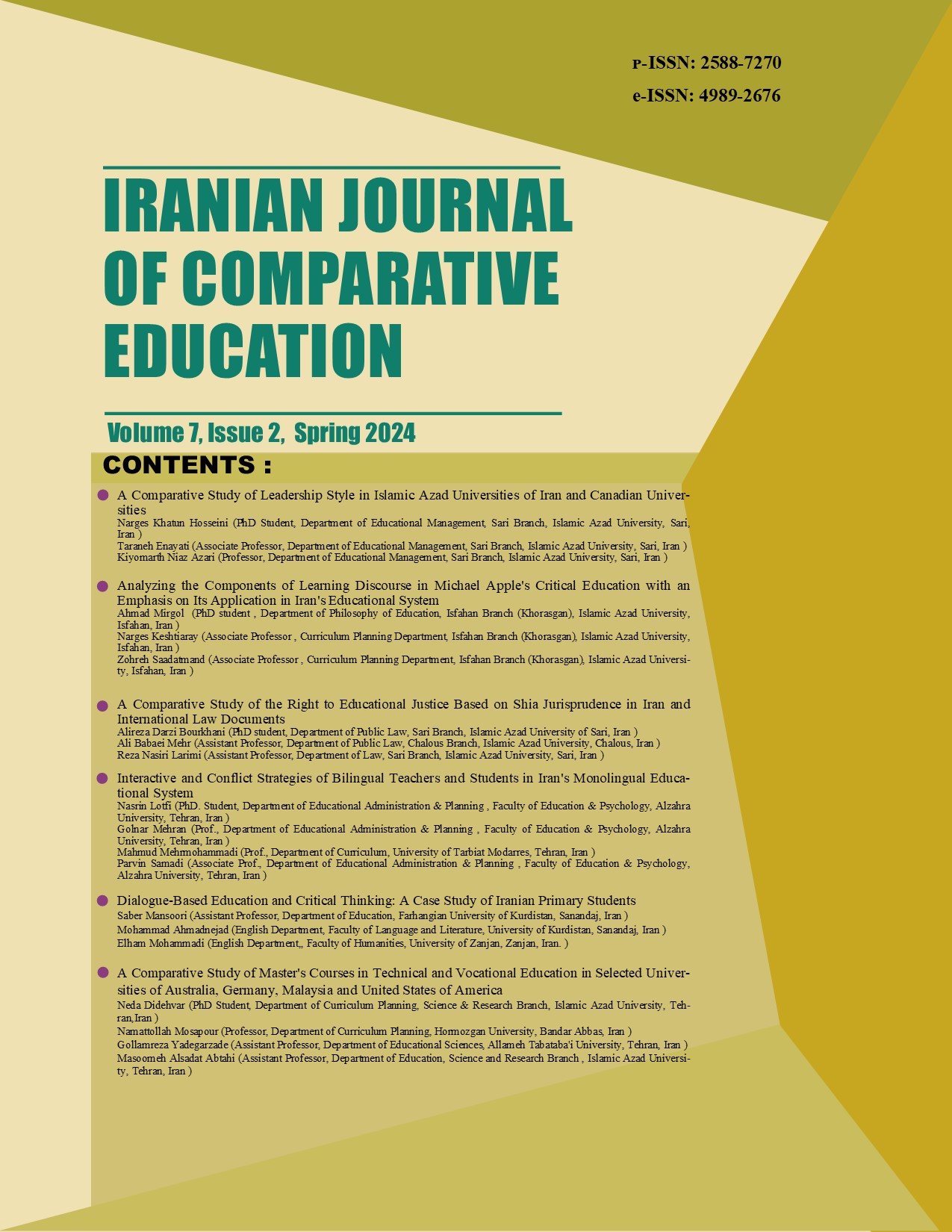
نوع مقاله : Original Article
تازه های تحقیق
-
موضوعات
Universities are extremely important as providers of human resources. Due to the complex dynamics of organizational structures, they need a strong leader who has the ability to interact with educated people such as faculty members and students. The concept of academic leadership was first presented by Ramsden (1994). This term refers to the leadership of key tasks such as leadership in teaching, research, setting common goals and visions and inspiring others (Mazari, Abili & Pourkarimi, 2018). Black (2015) considers higher education leadership capabilities to include things as setting vision & goals, focusing on organizational orientations, improving education process, and focusing on internal & external affairs. In order to achieve this goal, university leaders must overcome the challenges and re-harmonize structure of the educational system and government (Delshad, Ghorchian & Jafari, 2017). Future university leaders will live in a turbulent and chaotic environment where real power comes from recognizing patterns of change and measuring & seizing opportunities. In such an atmosphere, leaders need many competencies to survive (Keykha, Hovayda & Yghoubi, 2016). Research reveals that organizational success directly depends on leadership because the type of leadership affects satisfaction, quality of learning and education (Delshad, Ghorchian & Jafari, 2017; Deljoo Shahir, 2017, Panahandeh, 2015).
Nowadays, due to reasons such as progress in the level of skills and expertise of university employees, traditional theories of leadership are no longer responsive (Golafshani, Salehi & Zameni, 2017). Leadership style refers to the way the leader uses power and influence (Torabi, Salehnejad & Mosavi, 2021). It is also a set of managers' attitudes, traits and skills, which are formed based on four factors namely, value system, trust in employees, leadership tendencies and a sense of security in ambiguous situations (Sinai & Manzaritavakoli, 2015). The leader can choose different styles to guide the human force. Appropriate behavioral patterns of the leader will create a strong spirit and motivation in the employees and increase their productivity and satisfaction (Bromand, Vandad, Akbari & Falah, 2021). The leadership style determines the atmosphere, culture and strategies governing the organization (Rezazadeh Fashkhami, Farrokhi Lifshagard & Rahmatikhah Masuleh, 2015). Fiedler and Shmarz (2018) conclude that no specific style can be introduced as the superior style of leadership, because the successful style is different based on the characteristics of individuals and conditions of societies.
Research literature shows that there are basically two approaches related to leadership styles: First, an approach that examines the elements of organizational leadership, that is, the leader's person, followers, and contextual factors (Yukl, 2012). For example, Tang, Chen, van Knippenberg & Yu (2020), Sarwono, Jusuf & Sumarto (2019), Madugu & Abdul Manaf (2019) and Bunnoiko & Atthirawong (2017) indicated that the most important components of leadership are: Strategic thinking, entrepreneurship, foresight, patience, risk-taking, strategic thinking skills, performance improvement, organizational culture, knowledge sharing, innovative behavior and flexibility. The second approach measures different leadership styles in organizations and their relationship with employee performance. For example, Zamani and Chenari (2018) investigated relationship between leadership style and organizational commitment and organizational climate and found that transformational and pragmatic leadership styles are related to these two variables. Also, Gholami, Gholami & Bahrami (2009) found that the leadership style of educational managers provides a suitable platform for using learning organization components. Aghajani & Shoghi (2013) by examining the effect of managers' leadership style on employees' creativity showed that leadership style has an effect on employees' creativity flourishing of new ideas in individuals and in the organization. Fadavi (2016), investigated the effect of visionary leadership style on the green behavior of employees, the results of the research showed that the dimensions of this type of leadership (foresight, risk tolerance, empowerment, and motivation) have an effect on the environmental behaviors of employees.
In a study, Arab, Ahanchian & Karsheki (2012) studied the role of managers' transformational leadership style in predicting social entrepreneurship of employees in public and independent universities. Findings indicated that according to the ever-increasing changes and different expectations from universities, the transformational leadership style is a desirable leadership style for facing crises and organizational adversities and creating constructive changes. Van der Voet & Steijn (2021) investigated the relationship between team innovation and visionary leadership style through collaboration. The findings showed that team cooperation has a decisive role in the relationship between innovation and insightful leadership, and common perspectives and managers' attention to group decision-making and teamwork have potential benefits in this regard. Kadir, Tijani & Sofoluwe (2020), investigated relationship between visionary leadership style and creative behavior of employees in government educational colleges, showed that leadership empowerment has a positive and significant relationship with adaptability and creative behaviors of employees. Also, Rosing, Frese & Bausch (2011) by systematically reviewing the articles related to leadership styles, received the transformational leadership style has been introduced as an effective style (Zaech & Baldegger, 2017). In addition, servant leadership styles (Yoshida, Sendjaya, Hirst & Cooper, 2014), initiating Structure style (Keller, 2006) and visionary leadership style (Anderson-Fornell and Lyman, 1995) are among the effective leadership styles. In this research, the goal of transformational leadership is defined as creating job satisfaction and organizational commitment that leads to excellent customer service and overall performance improvement. This style of leadership is inspirational and seeks the collective interests of the organization rather than personal interests. In the structuring leadership style, the most important concern of the leader is to get things done, and she/he mainly deals with people directly with a top-down approach. Servant leadership style is considered a suitable strategy for improving organizational performance. Servant leaders instill in their followers a sense and desire to serve others. Also, visionary leadership style is one of the types of leadership approaches that has a human process and under the influence of transformation factors in dealing with needs, provides a vision of the goal. Servant leaders are the facilitating and motivating factors of employees and directly and indirectly affect the work efficiency.
According to what has been said, we need to briefly refer to the research problem. Islamic Azad University as one of the most extensive non -governmental universities of Iran (with more than four decades of establishment) has more than 530 branches in different cities. The exponential growth of the number of students in the 1980s and the rapid growth of academic units led to the appointment of managers who did not have the necessary capabilities to perform their duties. The managerial instability in Iran's higher education system over the past thirty years and tasteful performance rather than planning leadership can be considered as the problems of Islamic Azad universities. Currently demand for higher education has declined due to declining population growth rates, and Islamic Azad universities are faced with a decline in student.
Policymakers at this university have found that the change in professional missions has made the need to use capable leaders inevitable. The existing facts suggest that this university is in dire need of decent leaders, because its current managers are forced to make difficult decisions in the atmosphere of confusion and uncertainty. Also, the complexities of the modern world and emergence of phenomena such as internationalization of universities, scientific competitions and adverse financial conditions, formulate a specific, well -known and comprehensive framework for the leadership style at this university. To achieve this goal, the first step is to identify leadership styles. There are various methods for this identification. One way is to determine the leadership style from a comparative perspective. A comparative view can be informative, especially when comparing advanced and developing higher education systems. For this reason, the comparative view of the present researchers is focused on examining the status of Canadian universities. Canada is one of the countries with an advanced higher education system that has designed it so that it can use the potential and management capacity to use universities and synchronize global changes. Accordingly, the sub -goals of the research are:
In this study, a comparative (quantitative & quantitative) approach was used. In the qualitative section, the statistical population includes managers and faculty members of the selected universities. For analyze the data, the “Grounded Theory" was used. Also, the sampling was subject to the rules of this method and was targeted and theoretically selected and interviewed using the Snowball Sampling Method (19 participants including 10 from Islamic Azad University branches of Research & Science, North Tehran, Sari, Kerman and Ardebil and 9 universities of McGill, Toronto and British Columbia in Canada). For the selection of faculty members, criteria such as specialist in education management, research background and experience of management and executive activity at the university were considered. The data collection tool was a semi -structured interview. Thus, in the process of implementing interviews and notes, the new concepts and categories were recognizing and then enriching the categories was considered to identify and categorize the components of leadership styles. The process of interviewing was that the five main questions were identified based on the theoretical foundations and background of the research. The interview questions were approved by four professors of Islamic Azad universities. Prior to the interview, a consent letter along with basic details, including the goals of research and the questions, were sent to the participants by email. Due to the financial constraints of the principal researcher, interviews were conducted with Iranian participants in person and with Canadian interviewers via “Watts App”. In the interview, the main questions were raised and then sub questions - to understand better the attitudes and experiences of participants. For Canadian interviewees, questions were sent in English language by typing in “Watts App”, and the interviewees answered as "voice messages". After the implementation and notes and translation of it into Persian, the sub -questions that come to mind of principal research were again asked via “Watts App”. The process took place within a few consecutive days – with an average interview time between 40 and 60 minutes.
In Iran, interviews were recorded with permission from the interviewees. After each interview, they were fully implemented and coded to extract the basic concepts. MAXQDA software was used to analyze data. In the qualitative stage, the Guba and Lincoln's parallel criteria of credibility, dependability, conformability and transferability was used. The reliability was also conducted using the "percentage of agreement between the two coders" (the main researcher and researcher's colleague), which was % 83.
Table 1: Evaluation of the Reliability of the Interview Protocol
|
Interview number |
Number of codes |
Codes in agreement |
Reliability |
|
1 |
39 |
15 |
% 77 |
|
9 |
28 |
12 |
% 85 |
|
16 |
22 |
10 |
% 90 |
|
Total |
89 |
37 |
% 83 |
It was designed syntactic items using the five -value scale (from very less to very much). The formal and content validity of the questionnaire was confirmed by five professors of Islamic Azad universities and Canadian universities. The reliability of the questionnaire was reported through the Cronbach alpha coefficient, calculation and value (α = 0.926). Depending on the number of indicators in the model, 20 samples were selected for each index, and accordingly, the number of research samples includes all members of the universities under study were selected through relative class sampling method (total = 250). The questionnaire was sent to the participants’ e –mail address. Also, in the quantitative stage, AMOS, SPSS and Smart PLS Software were used to investigate the structural model of research variables and t test.
In this section, the researchers attempted to identify the dimensions of leadership style and the reasons for use of these dimensions through a semi -structured interview with faculty members of Islamic Azad universities and Canadian universities. The process of reviewing interviews, coding data, and extracting common themes was done to extract the final propositions from the continuous matching of the categories. These propositions were compared to the dimensions of leadership styles in scientific resources and research literature. It was also attempted to determine how much leadership style in the selected universities corresponds to the dimensions of assumed leadership styles.
Thus, different categories of leadership styles were extracted from the interviewees' words. For example, one of the interviewees said: "Monthly, semester and annual tasks are identified. The instructions are also issued in the form of directives and notifications, under the category of “determining the tasks and how they are performed and its timing", or in the case of the servant's leadership style. When one interviewee said: "my university is allowed to make decisions that increase their responsibilities" or "however, comments that are expressed with logic and reason are accepted"; these sentences were included in the category of "reliability" of the servant leadership style. Also, when one of the interviewees says, "One of the characteristics of visionary leadership is to have a prospect based on sufficient understanding of the organization's goals and transfer it to employees." Or "One of the features of our university is to accept new ideas and use that idea", these concepts are under the categories of visionary leadership style. In addition, concepts such as "creating a sense of necessity, explaining results of the goal, encouraging employees to fulfill the goals of organization" come under "mental encouragement" concept in the transformational leadership style. Through the analysis of the interviews, it was concluded which component of the leadership style in the university was considered and implemented. Through data analysis and coding, 79 codes consisted of 2 open concepts, 15 central categories, and 4 transformational, structural, service and visual leadership styles were determined. In the next step, using Delphi technique and opinions of academic experts, 15 categories and 72 concepts are finalized and conceptual framework of the research was presented (Table 2).
Table 2: Open and axial coding (identifying the categories and concepts of leadership styles)
|
Leadership Style |
Category |
Concepts |
|
Transformational
|
Mental encouragement |
· Encouraging employees to be creative · Preparing for a change in thinking · Employee participation in drawing the future vision · Mutual trust between managers and personnel · Creating talents and abilities of personnel · An invitation to do things in different and creative ways |
|
Ideal influence |
§ Integration and unity among managers and personnel § Reasonable risk-taking § Abolition of pride and pride in personnel to cooperate and participate with the leader § Strengthening the sense of power and competence § Emphasizing importance of having a strong sense of purpose § Abandoning individual facilities for sake of the group § Ensuring the removal of obstacles |
|
|
Inspired motivation |
· Drawing an optimistic and accessible vision · Create a common understanding of goals · Shaping expectations and goals · Creating hope in employees through being present in the text of the organization's issues |
|
|
Individual consideration |
§ Improvement and professional development § Personal development of managers § Using the team power of members § respect for others § Promotion of personal development § commitment |
|
|
Structural
|
Determine the duties and expectations of group members |
§ Compilation of programs § Determining tasks interactively § Determining the main frameworks of goals and activities |
|
Use fixed procedures and rules
|
· Doing things within the framework of standards · Full compliance with the manager's orders |
|
|
Implementation of leader's ideas after discussion in group |
o Fully clarifying your views to employees o Directing and guiding employees accurately o Determining degree of achievement of goals |
|
|
Determine tasks and how they are done and scheduled |
· Determining the schedule of tasks by leader · Specifying a specific behavioral framework · Determining the structure of division of duties |
|
|
Servant
|
Serving
|
· Willingness to serve · Serving people's needs and attention to them · Serving employees as one of main and important duties of the leader · Manager as a role model for serving others |
|
Trust
|
o Maintaining honesty and trust o Allowing employees to implement ideas o Attention to the suggestions of employees o Valuing employees through trusting them o Listening to employees without judgment |
|
|
Humility
|
§ Respect for employees § Sharing power § Helping employees in any situation § Having the necessary leadership skills |
|
|
Kindness
|
· Attention to employees · Support for employee rights · Encourage and acknowledge employees · Communicate verbally with personnel |
|
|
Visionary |
Create a vision
|
o Having vision and art of expression o Preparation for foresight and having full knowledge and emphasis on its importance o Having strategic thinking about existing issues o Environmental sensitivity o Change management and risk taking o Entrepreneurship management, creating opportunities and creating a new opportunity |
|
transfer of perspective (transfer of insight)
|
· Employee participation in decision making · Understanding the organization and organizational structure · Respect for people with knowledge · Knowing the critical situations of the organization, · Strategic choice of supporting organization and employees · Having problem solving skills · Creative leadership |
|
|
Empowerment |
· Motivate employees · Delegation of authority · Having systemic thinking · Getting feedback from work · Interaction between people in the system · Flexibility and assessment of situations · Looking at things from other people's points of view · Adapting to needs of the university |
In this section, the dimensions and components of leadership style obtained from quantitative data are discussed. In the modeling of structural equations using AMOS software, three indices of absolute, comparative and parsimonious fit were used to determine the fit of the model. Based on the results, the ratio value of Chi-square statistic (χ2) is equal to 2348/539 with a degree of freedom of 249 equal to 2.711. This value is between 1 and 3, which indicates the verification of the model. The goodness of fit index (GFI) is 0.893, which indicates the acceptability of this value for the optimal fit of the model. The value of root mean square error of estimation (RMSEA), which is another indicator of goodness of fit, is 0.064, which is acceptable and shows the confirmation of the research model, considering that it is less than 0.08. Other goodness of fit indices include the Tucker-Lewis Index (TLI) value of is 0.933; Bentler-Bonnet fit index (BBI) is 0.94; Comparative Fit Index (CFI) is 0.937 and the normalized parsimonious fit index (PNFI) is 0.645, which all indicate good fit and validation of the model (Table 3).
Table 3: Indices of Model fit
|
Interpretation |
Criterion |
Level
|
Fit index
|
Indices |
|
- |
- |
2348/539 |
Kai Square (χ2) |
Absolute |
|
- |
- |
249 |
Degree of freedom (df) |
|
|
Good fit |
Between 1 to 3 |
2/711 |
Chi-square ratio to degrees of freedom (χ2/df) |
|
|
Good fit |
more than 0.90 |
0/893 |
Goodness of fit index (GFI) |
|
|
Good fit |
more than 0.90 |
0.933 |
Tucker-Lewis Index (TLI) |
Comparative |
|
Good fit |
more than 0.90 |
0.94 |
Bentler-Bonnet fit index (BBI) |
|
|
Good fit |
more than 0.90 |
0.937 |
Comparative Fit Index (CFI) |
|
|
Good fit |
Less than 0.08 |
0.064 |
root mean square error of estimate (RMSEA) |
Parsimonious |
|
Good fit |
More than 0.05 |
0.645 |
Normalized parsimonious fit index (PNFI) |
Therefore, with the approval of the model, we are looking to investigate importance of the components of leadership style model in Islamic Azad Universities and Canadian universities. To answer, the averages of a variable with a fixed value were compared by means of a one-sample t-test. This test shows the importance of each component of leadership styles in selected universities. In the one-sample t-test, the researcher can usually compare the observed mean of the sample with a base number (test value). Since the questionnaire was on a five-point Likert scale, the midpoint of the test variable (number 3) was used as the basis for comparison. The first step in the t-test is to check the normality of the data, so it was checked using the Kolmogorov–Smirnov test. The results are specified below.
Table 4: The results of the Kolmogorov-Smirnov test for the normal distribution of data
|
Variables |
Value of z statistic |
Significance level |
Test result |
|
Mental stimulation |
0.178 |
0.077 |
Normal |
|
Ideal influence |
0.142 |
0.069 |
Normal |
|
Inspirational motivation |
0.146 |
0.082 |
Normal |
|
Individual consideration |
0.170 |
0.062 |
Normal |
|
Implementation of leadership ideas |
0.139 |
0.078 |
Normal |
|
Determining the duties and expectations of group members |
0.148 |
0.064 |
Normal |
|
Using fixed procedures and rules |
0.153 |
0.084 |
Normal |
|
Determining tasks, how to do them and scheduling |
0.195 |
0.072 |
Normal |
|
Service |
0.161 |
0.089 |
Normal |
|
Trust |
0.159 |
0.085 |
Normal |
|
Humility |
0.166 |
0.059 |
Normal |
|
Kindness |
0.147 |
0.080 |
Normal |
|
Create a vision |
0.173 |
0.073 |
Normal |
|
perspective transfer |
0.168 |
0.088 |
Normal |
|
Empowerment |
0.174 |
0.069 |
Normal |
Based on table (4), it is determined that the significance level of all the variables of this research is above 0.05. Therefore, the distribution of the data is normal and the hypothesis H0 that the data is normal is confirmed.
Table 5: t-test results of leadership styles in Islamic Azad Universities
|
Variables |
T statistic |
Significance level |
Mean difference |
Calculate the difference with 95% confidence interval |
|
|
Lower Limit |
Upper Limit |
||||
|
Mental stimulation |
- 0.171 |
0.431 |
- 0.02 |
-0.184 |
0.022 |
|
Ideal influence |
7.47 |
0.004 |
0.16 |
0/323 |
0.447 |
|
Inspirational motivation |
5.13 |
0.004 |
0.13 |
0.308 |
0.411 |
|
Individual consideration |
-3.72 |
0.261 |
0.07 |
-0.091 |
0.112 |
|
Implementation of leadership ideas |
12.24 |
0.001 |
0.52 |
0.498 |
0.613 |
|
Determining the duties and expectations of group members |
10.43 |
0.002 |
0.47 |
0.417 |
0.546 |
|
Using fixed procedures and rules |
11.89 |
0.001 |
0.49 |
0.432 |
0.598 |
|
Determining tasks, how to do them and scheduling |
13.52 |
0.001 |
0.67 |
0.510 |
0.693 |
|
Service |
-3.19 |
0.256 |
0.05 |
-0.053 |
0.098 |
|
Trust |
4.65 |
0.045 |
0.10 |
0.248 |
0.324 |
|
Humility |
-0.189 |
0.424 |
0.03 |
-0.159 |
0.063 |
|
Kindness |
-4.05 |
0.147 |
0.08 |
-0.099 |
0.131 |
|
Create a vision |
9.68 |
0.003 |
0.21 |
0.364 |
0.491 |
|
perspective transfer |
-1.61 |
0.311 |
0.04 |
-0.124 |
0.023 |
|
Empowerment |
5.36 |
0.004 |
0.11 |
0.295 |
0.386 |
Based on Table 5, considering that the significance level is rejected at the error level of 0.05, the categories of mental encouragement, individual consideration, service, humility, kindness and transfer of vision in the Islamic Azad universities have an average less than or equal to the test value of 3. It is also observed in the minimum and maximum levels that one is negative and the other is positive. Therefore, it can be concluded that from the perspective of the employees and members of the Islamic Azad Universities, the categories of mental stimulation, individual consideration, service delivery, humility, kindness and transmission of perspective have been neglected in the management and leadership of these universities. The average of other categories is higher than the value of the test (3) and is acceptable at a significance level of 95%.
Table 5: t-test results of leadership styles in Canadian Universities
|
Variables |
T statistic |
Significance level |
Mean difference |
Calculate the difference with 95% confidence interval |
|
|
Lower Limit |
Upper Limit |
||||
|
Mental stimulation |
13.94 |
0.001 |
0.83 |
0.511 |
0.695 |
|
Ideal influence |
12.45 |
0.001 |
0.58 |
0.364 |
0.453 |
|
Inspirational motivation |
13.45 |
0.001 |
0.77 |
0.492 |
0.671 |
|
Individual consideration |
10.08 |
0.003 |
0.27 |
0.287 |
0.349 |
|
Implementation of leadership ideas |
9.18 |
0.004 |
0.18 |
0.252 |
0.312 |
|
Determining the duties and expectations of group members |
7.65 |
0.007 |
-0.10 |
0.089 |
0.183 |
|
Using fixed procedures and rules |
8.13 |
0.006 |
-0.12 |
-0.137 |
0.241 |
|
Determining tasks, how to do them and scheduling |
8.41 |
0.005 |
0.15 |
-0.205 |
0.347 |
|
Service |
12.10 |
0.002 |
0.56 |
0.364 |
0.453 |
|
Trust |
11.53 |
0.001 |
0.47 |
0.321 |
0.532 |
|
Humility |
10.39 |
0.003 |
0.35 |
0.321 |
0.455 |
|
Kindness |
10.19 |
0.001 |
0.30 |
0.287 |
0.349 |
|
Create a vision |
13.11 |
0.001 |
0.71 |
0.389 |
0.495 |
|
perspective transfer |
12.86 |
0.001 |
0.64 |
0.378 |
0.461 |
|
Empowerment |
11.23 |
0.002 |
0.41 |
0.319 |
0.481 |
Based on Table 6, considering that the significance level is rejected at the error level of 0.05, the categories of using fixed procedures & rules, implementing leadership ideas and assigning tasks in the Canadian universities have an average of less than or equal to a test value of 3. It is also observed at the minimum and maximum level that one is negative and the other is positive. Therefore, it can be concluded that from the point of view of the staff and faculty members of selected universities in Canada, the categories of using fixed procedures & rules, implementing leadership ideas and assigning duties in the leadership of Canadian universities have been ignored, but more attention is paid to the dynamic component of leadership style. The average of other categories is higher than the value of the test (3) and is acceptable at a significance level of 95%. Here, the questionnaire was analyzed to determine priority of each leadership style and its components in Islamic Azad Universities and Canadian Universities. The results are shown in Tables 7 and 8.
Table 7: Prioritization of leadership styles based on the impact index in selected universities
|
Indicator
|
Islamic Azad Universities |
Canadian Universities |
|
Rank average |
Rank average |
|
|
Constructive leadership |
4.09 |
2.95 |
|
Insightful leadership |
3.86 |
3.91 |
|
Transformational leadership |
3.41 |
4.12 |
|
Servant Leadership |
3.23 |
3.44 |
As shown in Table 7, Structural leadership styles with an average rating of (4.09), visionary leadership with an average rating of (3.86), transformational leadership with an average rating of (3.41) and servant leadership with an average rating (3.23) are respectively the leadership priorities of managers in Islamic Azad Universities. In Canadian universities, transformational leadership styles with an average rating (4.12), visionary leadership with an average rating (3.91), servant leadership with an average rating (3.44) and constructive leadership with an average rank (2.95) shows the priority of the leadership styles. The priority of leadership style components in Islamic Azad Universities and Canadian universities is presented in Table 8.
Table 8: Prioritizing the components of leadership styles in selected universities
|
Indicator
|
Islamic Azad Universities |
Indicator
|
Canadian Universities |
|
Rank average |
Rank average |
||
|
Determining tasks, methods and timing |
4.32 |
mental stimulation
|
4.41 |
|
Determining the duties and expectations of group members |
4.28 |
Inspirational motivation
|
4.32 |
|
Implementation of leadership ideas |
4.11 |
Create a vision
|
4.25 |
|
Using fixed procedures and rules |
4 |
perspective transfer
|
3.10 |
|
Create a vision |
3.87 |
Ideal influence |
3.92 |
|
Ideal influence |
3.65 |
Service |
3.78 |
|
Inspirational motivation |
3.41 |
Trust
|
3.63 |
|
Empowerment |
3.32 |
Empowerment |
3.46 |
|
Trust |
3.11 |
Humility
|
3.30 |
|
Kindness |
3.02 |
Kindness |
3.23 |
|
Individual consideration |
2.98 |
Individual consideration
|
3.14 |
|
Service |
2.84 |
Determining the duties and expectations of group members |
2.57 |
|
Perspective transfer |
2.71 |
Determining tasks, how to do and scheduling |
2.44 |
|
Humility |
2.63 |
Implementation of leadership ideas |
2.31 |
|
Mental stimulation |
2.51 |
Using fixed procedures and rules |
2.28 |
According to Table 8, it can be said that in Islamic Azad Universities, the indicators of determining tasks & scheduling with an average rank of (4.23), determining the tasks & expectations of group members with an average rank of (4.28), implementation of leadership ideas with an average rating of (4.11), have the highest priority and indicators of mental persuasion with an average rating of (2.51) and humility with an average rating (2.63) have the lowest priority respectively. In Canadian universities, indicators of mental motivation with an average rating of (4.41), inspirational motivation with an average rating of (4.32) and creating a vision with an average rating of (4.25) have the highest priority and the indicators of use of fixed procedures & rules with an average rank of (2.28) and implementation of leadership ideas with an average rank of (2.31) have the lowest priority respectively. Based on the results of the tables, it is possible to make a comparative comparison of the leadership style in selected universities of Iran and Canada (Table 9).
Table 9: Comparison of leadership style categories in the studied universities of Iran and Canada
|
Country |
Number of similar categories |
Number of different categories |
Less important categories |
Important categories |
|
Iran |
6 |
6 |
· Mental persuasion · Individual consideration · Service · Humility and humility · Kindness · Transfer of perspective |
- Determining tasks, how to do things and scheduling |
|
Canada |
6 |
3 |
- Using fixed procedures and rules - Implementation of leadership ideas - Determining tasks, how to do things and scheduling |
· Mental persuasion
|
Universities, as one of the most important educational institutions of any country, must have a strong leadership and management system in order to play a role in the international scene. Leadership is a key factor for improving university performance. The success or failure of any university depends on the effectiveness of its leadership at its all levels. According to the findings, the components of all four leadership styles can be observed simultaneously in the selected universities. The use of different and even contradictory leadership styles - according to the needs - has already been considered (Ghafouri, Elyasi, Amiri & Seyednaghvi, 2018). But what is evident in this research is the use of structural leadership style and little attention to other styles in Islamic Azad Universities. Considering the components of the structuring leadership style, leaders of Islamic Azad Universities insist on performing tasks according to assigned procedures, while this narrows the field for staff dynamics. Also, another finding indicates that important components such as mental encouragement, individual consideration, service, modesty, kindness, and transmission of perspective have not been taken into consideration in Islamic Azad Universities. In other words, in Iranian universities, the components of transformational, servant and visionary leadership styles have attracted the least attention of leaders. The findings show that in Canadian universities, components such as fixed procedures & rules, implementation of leadership ideas, and assignment of duties & schedules are not given much attention by university leaders. On the contrary, the components of transformational, visionary and servant leadership styles have been considered in the leadership process of these universities.
Considering the findings of the research, in the comparison between the leadership style in the Islamic Azad Universities of Iran and the universities of Canada the following can be stated: In the field of organizational formats and structures in Iranian universities, hierarchical structures and central-oriented is prominent and decisions are mostly made from the top to down. Leaders in these academic climates usually make key decisions personally, and the rest of the members have less independence in the decision-making process. On the contrary, in Canadian universities, democratic educational structures are more prominent and decisions are made in cooperation and consultation with members. Leaders in this environment tend to listen to members' opinions and suggestions, and decisions are made jointly by teams and groups. Regarding the approach of communication and human values, it can be mentioned that in Islamic Azad Universities, personal and intimate communication between leaders and employees is less due to efforts to maintain cultural respect and traditional credibility. Therefore, people's communication with leader is generally focused on assigned tasks and goals. In Canadian universities, establishing personal relationships and human values are very important. Leaders in this environment focus on positive interactions, active listening, and respect for members' opinions. For this reason, understanding the emotions of employees, regulating human behavior & increasing acceptability, and responding & solving problems in Canada has provided the ground for effective leadership of universities.
Regarding the component of personal empowerment & development in Islamic Azad Universities of Iran, personal empowerment and professional development is usually done through participation in direct training courses. The leaders of these universities usually play a major role in making decisions and professional development of staff, faculty and students. On the contrary, in Canadian universities, individual empowerment and professional development takes place through the approach of cooperation and companionship. The leaders of these universities tend to develop the skills, independence and motivation of the employees. In general, the approach of cooperation and companionship in Canadian universities shows a focus on humanism and the active participation of members in the decision-making process and individual development. This approach not only improves the working and learning environment in universities, but also leads to increasing the satisfaction and commitment of members and improving their organizational performance. Therefore, it can be said that the real skill of a university leader is manifested in her/his ability to positively interact with employees to fulfill the university's missions. Transformational, servant and visionary leadership styles play an important role in synchronizing people in the organization and harmonizing their efforts to realize the university's visions. Based on findings, it is suggested that Islamic Azad Universities should compile and implement programs for the development of managers' abilities and capabilities regarding transformational, servant and visionary leadership styles.
-